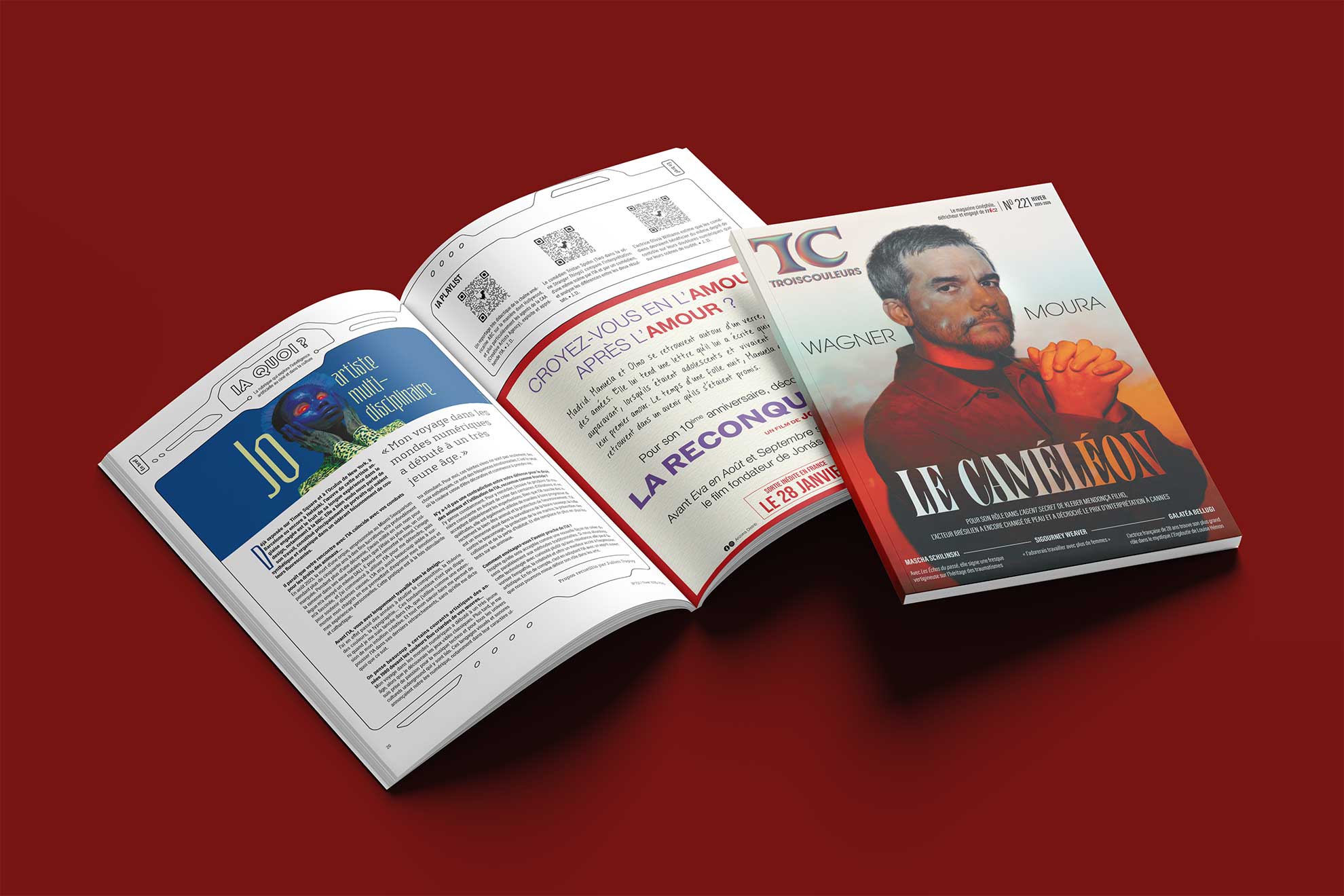
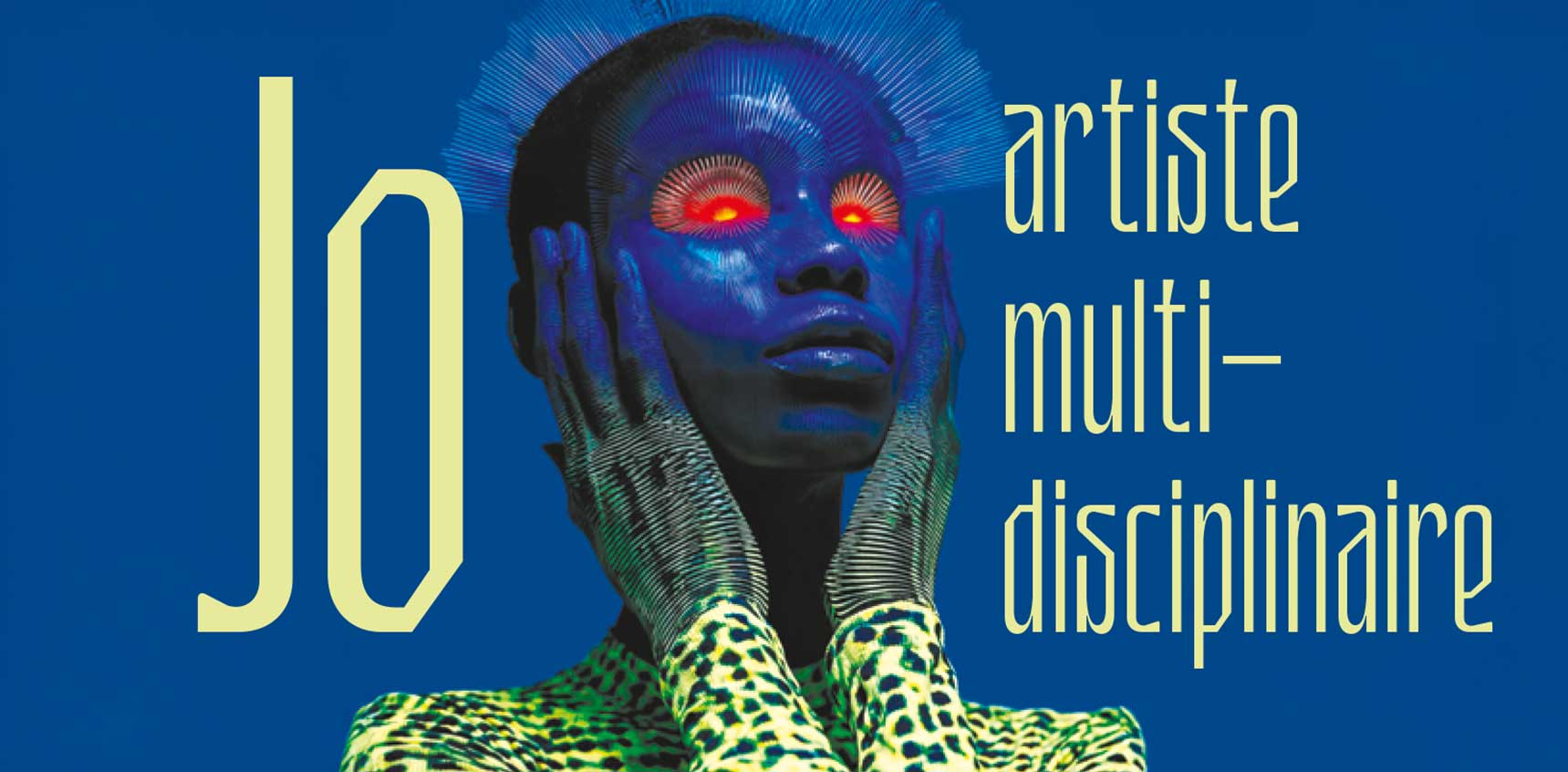
I recently had the opportunity to be interviewed by Julien Dupuy for Trois Couleurs Magazine, a Paris-based monthly online and print magazine that focuses on culture, cinema, and technology, where we discussed my work with AI and the creative possibilities it opens up. We spoke about the evolving relationship among art, innovation, and ethics, as well as how AI is reshaping how ideas are developed and expressed. It was an engaging and thoughtful exchange that allowed me to reflect on my practice.
– Could you introduce yourself and provide an overview of your career?
I am a graphic designer and multidisciplinary artist with over 30 years of experience. I launched my career in London’s publishing industry as an Art Editor for the BBC, Haymarket, and the inaugural Big Issue Magazine. My AI work has been exhibited internationally, including Times Square and The Oculus at the World Trade Center in New York, as well as in Miami, Spain, and Helsinki. Collaboration and creativity are at the heart of my practice, and I take pride in using my skills to make a positive impact. My work for animal advocacy campaigns have raised awareness, generated significant media coverage, and engaged the public. For me, creativity is an evolving journey where design, technology, and imagination converge to challenge conventions, ignite dialogue, and inspire meaningful change.
– How did you first come across generative AI? What was your initial reaction to these tools?
I briefly encountered AI a few years ago. However, my activism work consumed my time. I never pursued it further. In August 2023, a devastating event occurred. The tragic passing of Tokitae, an orca imprisoned at the Miami Seaquarium for over 50 years for profit and entertainment, deeply impacted me. Toki was and still is a profound inspiration to me. For over a decade, I campaigned on her behalf and co-led a global campaign to return her to her home waters. Events and experiences left my heart shattered. I experienced burnout, which badly affected my health. My colleague sent me a Dall-E meme to cheer me up. I was fascinated by it and began using AI for light relief and then to make a difference, one meme at a time, supporting various causes and campaigns. AI has significantly helped my grief journey by enabling the expression of my emotions and personal experiences. This practice is both empowering and deeply cathartic.
– I understand that you had extensive design experience even before AI came along. Do you think this background makes you a more effective user of AI?
Yes, I think my background in design fundamentally shapes how I approach AI. Before AI tools existed, I spent years learning composition, colour theory, typography, and how to communicate emotion through form. Those foundations didn’t disappear when AI came along. I treat AI as an extension of my creative intuition, not a replacement for it. My understanding of balance, rhythm, and storytelling lets me push AI further, rather than letting it dictate the outcome.
– The very bright, fluorescent colours seem to evoke certain artistic trends of the 1980s. Is this a deliberate influence on your part? More generally, where does your taste for these bright colours come from?
My journey in the digital world began at a young age through the captivating world of classic video games, and evolved into a love for techno music and its vibrant culture of underground spaces with their own visual and sonic language that mirrors our current digital age: dazzling, seductive, and overstimulating. For me, those bright, synthetic hues aren’t just aesthetic choices; they’re emotional frequencies. They speak of connection, escape, and transformation. It’s a threshold where colour stops being decorative and starts to feel alive and charged with emotion; representing both liberation and disorientation. I love that tension. It’s the hue of life turned electric, of memory bathed in artificial light —a celebration and a critique that reflects the beauty of energy and life, yet also the distortion of hyper-visibility. They pull the viewer in, then make them question what’s beneath that shine.
– In some of your works, there is a fascinating tension between the wild subjects (such as animals and plants) and the artificial way you depict them. What are you trying to convey with this contrast?
That contrast is the core of my practice. I’m fascinated by how technology mediates our relationship with nature. When I depict animals or plants in a clearly artificial way—metallic textures, glitch-like surfaces, neon veins—it’s not to dehumanize them, but to show how entangled we’ve become with the artificial world. It’s a reflection of the Anthropocene: wildness filtered through circuitry, organic life rendered through an algorithm. It’s both a mourning and a metamorphosis.
– Another fascinating contrast I detect in your work, particularly in the series dedicated to Palestine, is that between a very modern rendering and images that evoke photographs from the 19^(th) or early 20^(th) century, particularly in the way movement is broken down, as in Muybridge’s work, for example. Is this the case?
It’s interesting that you mention Muybridge. Although not a conscious influence, his work is part of my visual memory and shapes my understanding of the relationship between motion and stillness. I have often experimented with long exposures and sequential imagery in my personal photographic work. So when I look back at the Palestine series, I can see how that connection emerges—not as a direct reference, but as an echo of similar concerns: fragmentation, repetition, the poetry of movement interrupted. It’s less about paying homage and more about exploring how modern technology can carry that same fascination with time—how digital processes can still hold something human, something lingering between moments.
– I also feel that light painting has influenced your work. Is that the case?
I’ve always loved the way light painting blurs movement and time. In a sense, AI allows me to paint with light again—just in a new medium. There’s something ephemeral and spiritual about light traces, and I often try to incorporate the same feeling into my digital work. Each stroke of light, whether captured by a camera or generated by an algorithm, is an act of inscription—a record of presence.
– Do you ever combine AI with other media, such as photography? I get the impression that this is sometimes the case.
I work with a huge creative arsenal — my own photography, scanned materials, and digitally created textures that I’ve built over the years. These form the backbone of my visual language. When I use AI, I rarely start from scratch; I feed it fragments from my archive — images, patterns, surfaces — so the work always carries my own fingerprint.
– You are very active in the animal rights movement. However, we know that AI is very water- and energy-intensive, and therefore potentially harmful to the animal world. How do you reconcile the two?
That’s a very real tension, and one I think about constantly. As someone involved in animal rights, I can’t ignore the energy cost of AI. To address this, I try to produce consciously by avoiding the creation of hundreds of iterations and intentionally embrace imperfections, finishing my work in Photoshop. While there are concerns about AI, it is also being used in ways that directly advance animal welfare and environmental protection. For example, AI supports wildlife monitoring, anti-poaching efforts, protection of marine life, prevention of collisions and habitat loss, climate and ecosystem modeling, and the crucial replacement of animal testing. Despite criticism of AI, many overlook a far greater threat: animal agriculture remains one of the largest, yet often ignored, consumers of water on Earth.
– Your style is very consistent, which is not obvious with AI. Did you struggle a lot to learn how to master the tool?
I wouldn’t say I struggled, and I wouldn’t say I’ve mastered it either. AI is constantly evolving — there’s always more to learn. What I’ve developed is a sense of how to guide it toward the results I want, rather than accepting an instant generation. I love to remix, include my references, and keep experimenting. That balance between structure and surprise keeps the process alive for me — it’s where the real creative pleasure lies.
– What are your fears, or on the contrary, your hopes for the future of AI?
That’s a huge question. There are many hopes and just as many fears. In my field, I hope AI is accepted as a valuable part of the artist’s toolkit—a new way to create meaning alongside traditional methods. If we approach this technology with curiosity rather than resistance, it can foster empathy, creativity, and greater access to artistic expression. Ultimately, embracing AI with an open mind will help us shape its role in the arts for the better.