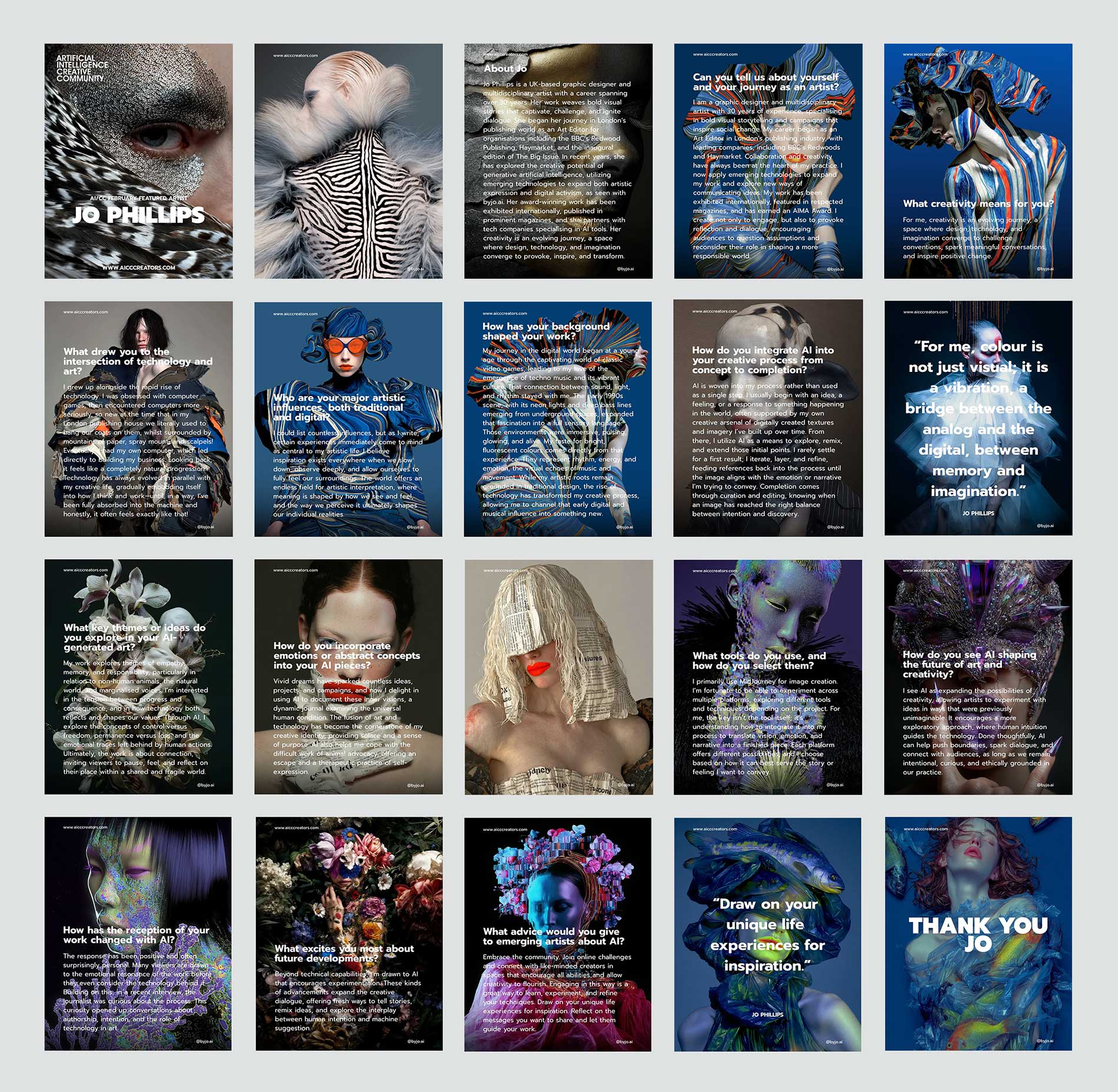
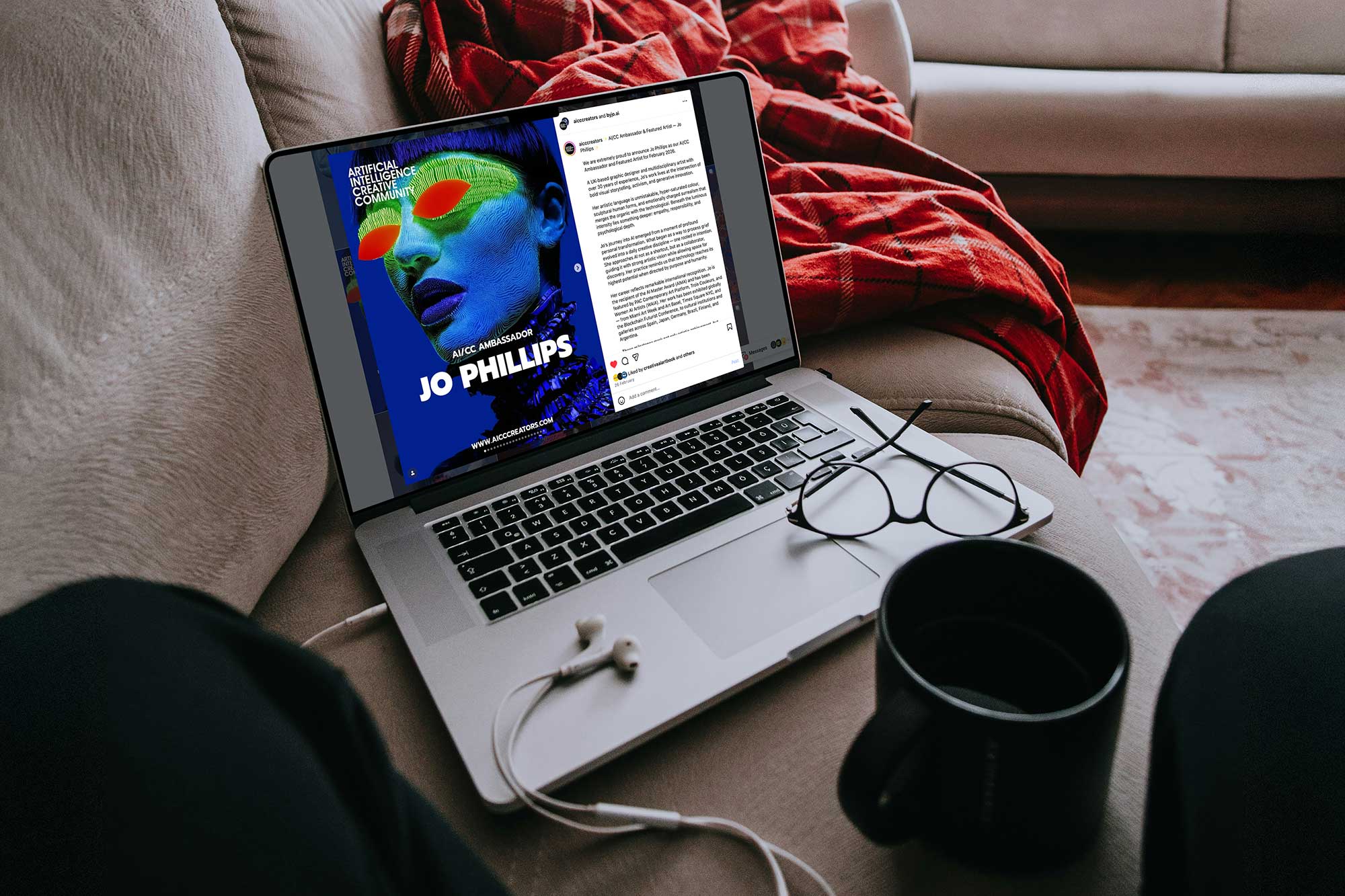
I am truly honoured to serve as an ambassador for Artificial Intelligence Creative Community (AI/CC) —a community I have long admired for its inclusivity, inspiration, and steadfast commitment to creativity. Representing AI/CC means leading by example and demonstrating that technology achieves its greatest impact when guided by intention and purpose. Through my work, I aim to inspire others to harness AI for empowerment, innovation, experimentation, and authentic self-expression.
Artist Feature Questions
Background and Inspiration
1: Can you tell us about you and your journey as an artist? How did you begin working with AI?
I am a graphic designer and multidisciplinary artist with 30 years of experience, specialising in bold visual storytelling and campaigns that inspire social change. My career began as an Art Editor in London’s publishing industry, with leading companies, including BBC’s Redwoods and Haymarket.
Collaboration and creativity have always been at the heart of my practice. I now apply emerging technologies to expand my work and explore new ways of communicating ideas. My work has been exhibited internationally, featured in respected magazines, and has earned an AIMA Award.
I create not only to engage, but also to provoke reflection and dialogue, encouraging audiences to question assumptions and reconsider their role in shaping a more responsible world. For me, creativity is an evolving journey, a space where design, technology, and imagination converge to challenge conventions, spark meaningful conversations, and inspire positive change.
2: What drew you to the intersection of technology and art?
I grew up alongside the rapid rise of technology. I was obsessed with computer games, then encountered computers more seriously—so new at the time that in my London publishing house we literally used to hang our coats on them, whilst surrounded by mountains of paper, spray mount, and scalpels! Eventually, I had my own computer, which led directly to building my business.
Looking back, it feels like a completely natural progression. Technology has always evolved in parallel with my creative life, gradually embedding itself into how I think and work—until, in a way, I’ve been fully absorbed into the machine… and honestly, it often feels exactly like that!
3: Who are your major artistic influences, both traditional and digital?
I could list countless influences, but as I write, certain experiences immediately come to mind as central to my artistic life. I believe inspiration exists everywhere when we slow down, observe deeply, and allow ourselves to fully feel our surroundings. The world offers an endless field for artistic interpretation, where meaning is shaped by how we see and feel, and the way we perceive it ultimately shapes our individual realities.
My creative journey began early, growing up immersed in books, writing, and hands-on practices such as drawing with pen and ink, charcoal, and oil pastels, as well as pottery, which later led to formal education in the arts. Time spent in nature has been equally inspiring. My mindful photography, together with a deep love of the arts and music, bridges my traditional influences with my digital practice, shaping how I observe, document, and translate lived experience into art.
4: How has your cultural background or personal experiences shaped your work?
My journey in the digital world began at a young age through the captivating world of classic video games, leading to my love of the emergence of techno music and its vibrant culture. That connection between sound, light, and rhythm stayed with me. The early 1990s scene, with its neon lights, and deep bass lines emerging from underground spaces, expanded that fascination into a full sensory language.
Those environments were immersive, pulsing, glowing, and alive. My taste for bright, fluorescent colours comes directly from that experience. They represent rhythm, energy, and emotion, the visual echoes of music and movement.
While my artistic roots remain grounded in traditional design, the rise of technology has transformed my creative process, allowing me to channel that early digital and musical influence into something new. For me, colour is not just visual; it is a vibration, a bridge between the analog and the digital, between memory and imagination.
5: Can you describe a turning point in your career where AI became central to your art?
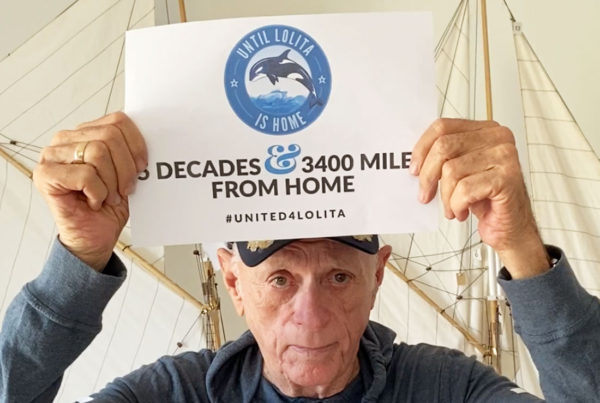
I first encountered AI a few years ago, but didn’t pursue it seriously, as my activism work took priority. Everything changed in August 2023 after the death of Tokitae, a captive orca whom, for over a decade, I had campaigned daily for. The loss left me burnt out and grieving. A colleague sent me a simple DALL·E meme to lift my spirits, and that gesture reignited my curiosity.
I began using AI to process grief, express emotions, and support causes, and started a 365-day challenge that led me to join creative communities and participate in online challenges. As I became more immersed, AI moved to the centre of my practice. Today, it is something I engage with daily, both as a creative discipline and a form of emotional expression.
Creative Process
1: How do you integrate AI into your creative process from concept to completion?
AI is woven into my process rather than used as a single step. I usually begin with an idea, a feeling, or a response to something happening in the world, often supported by my own creative arsenal of digitally created textures and imagery I’ve built up over time.
From there, I utilize AI as a means to explore, remix, and extend those initial points. I rarely settle for a first result; I iterate, layer, and refine, feeding references back into the process until the image aligns with the emotion or narrative I’m trying to convey. Completion comes through curation and editing, knowing when an image has reached the right balance between intention and discovery.
2: What tools, techniques, or AI models do you use, and how do you select them?
I primarily use MidJourney for image creation. I’m fortunate to be able to experiment across multiple platforms, exploring different tools and techniques depending on the project. For me, the key isn’t the tool itself; it’s understanding how to integrate it into my process to translate vision, emotion, and narrative into a finished piece. Each platform offers different possibilities, and I choose based on how it can best serve the story or feeling I want to convey.
3: How much control do you delegate to the AI versus your input?
I view AI not as a substitute for decision-making but as a versatile instrument in a broader creative process. My input defines the vision, directs the composition, and sets the mood, while AI uncovers options, produces alternatives, and reveals unforeseen directions beyond my initial imagination. I seldom accept the first result; balance emerges through repeated refinement. The ongoing interplay between human intent and machine recommendation fuels much of the creative spark.
4: Could you describe a typical day in your studio when working on an AI-driven project?
Lots of tea… 🙂
5: How do you overcome creative blocks when working with AI?
I honestly haven’t encountered creative blocks; my mind is constantly overflowing with ideas. There never seems to be enough time to manifest all my dreams and thoughts, or to fully express how I feel about the world around me. That said, if I ever need to shift direction or open up a new channel of thought, I turn on the radio and let music guide me. Sound has a way of unlocking pathways and rhythms that visuals alone can’t, and it often leads me somewhere unexpected.
Thematic Exploration
1: What key themes or ideas do you explore in your AI-generated art?
My work explores themes of empathy, memory, and responsibility, particularly in relation to non-human animals, the natural world, and marginalised voices. I’m interested in the tension between progress and consequence, and in how technology both reflects and shapes our values.
Through AI, I explore the concepts of control versus freedom, permanence versus loss, and the emotional traces left behind by human actions. Ultimately, the work is about connection, inviting viewers to pause, feel, and reflect on their place within a shared and fragile world.
2: Are there any societal, ethical, or philosophical questions that your work addresses?
AI is a versatile and potent medium for engaging with social issues, and my work explores several of these intersections. I am interested in how AI can be used not simply to illustrate ideas, but to provoke emotional responses, surface empathy, and invite deeper reflection on the relationships between humans, non-human animals, and our shared existence.
3: How do you incorporate emotions or abstract concepts into your AI pieces?
Vivid dreams have sparked countless ideas, projects, and campaigns, and now I delight in using AI to document these inner visions – a dynamic journal examining the universal human condition. The fusion of art and technology has become the cornerstone of my creative identity, providing solace and a sense of purpose. AI also helps me cope with the difficult work of animal advocacy, offering an escape and a therapeutic practice of self-expression.
Artistic Impact and Audience Engagement
1: How has the public and critics’ reception of your work evolved with the use of AI?
The response has been positive and often surprisingly personal. Many viewers are drawn to the emotional resonance of the work before they even consider the technology behind it.
Building on this, in a recent interview, the journalist was curious about the process. This curiosity opened up conversations about authorship, intention, and the role of technology in art.
2: What is the most memorable reaction you’ve received to one of your AI-generated pieces?
One that sticks in my mind was seeing my piece about Tokitae displayed during Miami Art Week in Wynwood. It was incredible to witness my work being accepted, published, and exhibited. For those in my close-knit advocacy circle who had shared the years of highs and lows alongside me, it was deeply emotional. To take this work forward, see it displayed, and later have an article featured in Art Odyssey’s magazine, entitled ‘Healing,’ was completely overwhelming.
3: How do you engage with audiences who may be unfamiliar with AI art?
I focus on making the work approachable and emotionally resonant, rather than emphasising the technology behind it. I aim to create images that tell stories, evoke feelings, or spark curiosity, so that viewers can connect with the work on a human level.
I also provide context where needed, explaining my process and the role of AI as a tool, not a replacement for creativity. Encouraging questions, dialogue, and reflection helps demystify AI and shows that it is a medium for expression, just another way to translate ideas, experiences, and emotions into visual form.
Technology and Future Perspectives
1: How do you see AI shaping the future of art and creativity?
I see AI as expanding the possibilities of creativity, allowing artists to experiment with ideas in ways that were previously unimaginable. It encourages a more exploratory approach, where human intuition guides the technology. Done thoughtfully, AI can help push boundaries, spark dialogue, and connect with audiences, as long as we remain intentional, curious, and ethically grounded in our practice.
2: Are there any specific advancements in AI you’re excited to explore in your future works?
Beyond technical capabilities, I’m drawn to AI that encourages experimentation. These kinds of advancements expand the creative dialogue, offering fresh ways to tell stories, remix ideas, and explore the interplay between human intention and machine suggestion.
3: How do you stay informed about AI developments and integrate new tools into your creative process?
I stay informed by constantly exploring and experimenting, keeping up with developments in AI communities and platform updates. I also participate in creative partner programs, which provide early access to new features and insights, allowing me to test innovations firsthand.
4: What advice would you give to emerging artists who want to start working with AI?
Embrace the community. Join online challenges and connect with like-minded creators in spaces that encourage all abilities and allow creativity to flourish.
Engaging in this way is a great way to learn, experiment, and refine your techniques.
Draw on your unique life experiences for inspiration. Reflect on the messages you want to share and let them guide your work.
Cultivate curiosity. Dare to experiment, break away from conventional styles, and keep expanding your knowledge while engaging with the world around you.
Remember your original purpose, and don’t be afraid to step back when needed. Avoid feeling pressured by trends, algorithms, or follower counts, as they can drain your energy and distract from your vision.
Stay focused, keep creating, and remain true to yourself. That’s when your unique talents will shine. Above all, enjoy every moment of your creative journey.